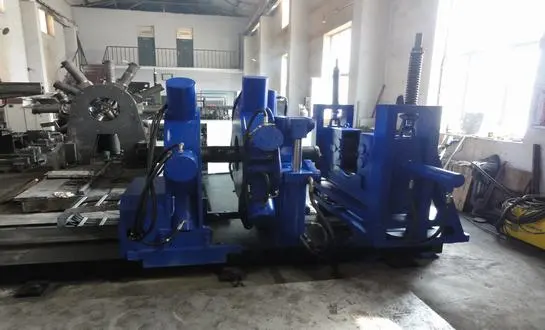
Key Components of Efficient Bucking Systems
Power System
The power system provides the force to spin the work assembly and torque the threaded connection. Hydraulic Bucking Units use hydraulic power delivered from the drive system to provide the necessary torque.
Torque capacity is one of the main parameters when choosing a unit, however it should not be used in isolation. The torque needed must be compatible with the tube connection and operating circumstances. Welong’s published Bucking Unit models encompass multiple torque ranges, enabling equipment selection to be tailored to varied tubular diameters and applications.
A correctly constructed power system must also provide controlled rotation, not just maximum output. Controlled torque application helps operators perform consistent make-up and break-out procedures, while decreasing the likelihood of delivering inappropriate force to the connection.
Gripping Mechanism
When torque is applied the gripping mechanism firmly grips the tubular components. The tube may move relative to the working assembly without stable grasping, and the rotating force is not conveyed properly.
The standard Bucking Unit employs powered jaws or grasping elements with a backup unit. Welong characterises its Bucking Units as having a non-stick gripping mechanism. Its more general product information on Bucking Units and Power Tongs includes powered tong assemblies, hydraulically controlled jaws, backup assemblies and a supporting frame as the major features of the system.
Gripping arrangement is especially critical when the equipment is required to handle various tubular diameters. Depending on the model, jaw configurations, ranges of motion or replaceable grasping components might vary. Users should check the pipe sizes needed before they choose equipment instead of presuming that one configuration would work for all applications.
Torque Control System
Bucking Unit functioning requires torque control as threaded connections need regulated make-up and break-out force. Insufficient torque may not allow the joint to attain the proper state, while uncontrolled or excessive torque may create unneeded stresses on the joint.
Today's Bucking Units have the ability to measure and record torque. Welong says its Bucking Units use a precise torque-control system and are computer-monitored throughout the screwing operation. Dedicated torque recorders for various models are also part of the product range.
In production or service contexts where repeatability is important, recorded torque information may also offer helpful operational records. The actual control technique and recording arrangement will nevertheless depend on the equipment type and the application.
Thread Alignment System
Ensure correct alignment of threaded components before engagement. If the tubulars are not aligned properly, the connection may not be completed smoothly and the potential of thread damage or an inaccurately produced connection is increased.
Therefore, thread alignment should be addressed combined with grasping and placement, and not as a separate feature. The frame, jaws and backup assembly, along with the operating method, all work together to retain the components in the right place during make-up or break-out.
This is particularly true for equipment handling tubulars of varying diameters. Usable range and mechanical design are especially critical. Welong's published specifications for Bucking Units show multiple models with varied application ranges, centre heights, hole sizes and torque capabilities.
Optimizing Bucking Unit Performance: Expert Tips
Regular Maintenance and Calibration
Equipment subjected to high torque and hydraulic loads over and over again must be regularly inspected. Maintenance should be concentrated on those parts which have a direct effect on gripping, torque transfer, hydraulic functioning and placement.
Depending on the unit layout, maintenance procedures may involve testing hydraulic components for leakage, evaluating gripping parts for wear, and analysing mechanical connections and validating the integrity of torque measuring devices.
You also want to examine the manufacturer’s recommendations for maintenance and calibration for any torque-related equipment. Good inspection records may show performance changes before they cause production problems.
It’s not only about prolonging the life of the equipment. This regular maintenance also allows the Bucking Unit to operate within its designed performance range.
Operator Training and Certification
A nicely built Bucking Unit still has to be operated correctly. Operators must be familiar with the operating range of the equipment, the gripping method, the torque settings, emergency controls, and necessary safety protocols.
Training should be done on actual tubulars and connectors being used. Operators should understand the proper jaw or grasping configuration for the pipe size and how to recognise aberrant movement, hydraulic difficulties, or connection problems.
Welong offers several configurations of Bucking Unit, such as manual, semi-automatic and completely automated. So the operation process and training needs may differ from system to system.
Instead of operator training being a one-off effort, organisations may include training on the equipment inside the regular inspections and operating evaluations. This helps to ensure consistent practices while changing operators or apps.
Implementing Advanced Monitoring Systems
Monitoring may increase the visibility of relevant operational metrics, notably torque. Torque recording gives essential information regarding the make-up or break-out process for situations where repeatability is crucial.
In fact, Welong’s Bucking Unit product description clearly states that computer monitoring and torque recording are part of the equipment setup.
Monitoring should not be about collecting additional data, but about informing pragmatic decision making. The useful information may enable operators to spot odd torque behaviour, compare operational cycles and analyse issues with particular connections.
The level to be monitored depends on the application. More intensive monitoring may be needed for a completely automated production system than for a simple manual or semi-automatic arrangement.
Customizing for Specific Applications
Not all tube handling applications have the same needs. Equipment selection may be influenced by the pipe diameter, connection type, needed torque, area available for operation, production volume, and the degree of automation.
Therefore, the selection of a Bucking Unit based only on the maximum torque might lead to a suboptimal setup. “Evaluate the entire operating range.
This variance is seen in the published models of Welong. The Bucking Units are available for various pipe sizes, ranging from smaller tubular applications to larger diameter designs, with variable torque capabilities and mechanical specifications.
Buyers seeking a tailored solution should supply critical application details, such as tube size, connection requirements, target torque, operating environment and desired level of automation. This provides the manufacturer with a more solid foundation for proposing a suitable setup.
Future Trends in Bucking Technology
Automation and Robotics
Automation is a major growth area for tubular handling and make-up/break-out processes. Automated equipment may minimise the amount of human intervention necessary for repeated activities, and can promote more consistent operating practices.
This tendency is already evident in the wider tubular-handling business. SLB, for example, defines a horizontal tubular handling system that includes a side-entry bucking machine to make up and break out drilling tubulars, BHA components and casing away from the well centre.
Further automation for Bucking Units might include automatic positioning, grasping, torque control and process monitoring. However, the extent of automation should be tailored to the real process and not be a must for every application.
AI-Driven Predictive Maintenance
The amount of operational and maintenance data generated by machines is increasing, and AI-based predictive maintenance is a possible growth area for oilfield equipment.
Future systems for Bucking Units might employ operational data, such torque behaviour, hydraulic parameters, cycle information and maintenance records, to recognise changes in the state of the equipment.
However, these applications should be differentiated from Bucking Unit functionalities presently specified. Torque control and monitoring are proven functionalities in Welong’s published product material, whereas AI-based predictive maintenance should be regarded a path for development and not promoted as a standard feature of existing Bucking Units.
Enhanced Material Technologies
The choice of the material and the production procedures affect the endurance of mechanical components subjected to repetitive loads, contact and severe working conditions.
For Bucking Units, the gripping elements, driving components, frames, hydraulic-related parts, etc. should be constructed according to the mechanical requirements. Improving machining, heat treatment, surface treatment and the selection of materials may provide longer service life and more reliable performance.
Any material upgrades should be balanced against the real operational needs. A material that works well in one component or application is not always the best solution for every portion of a Bucking Unit.
Integration with Digital Twins
Digital twin technology may be used for equipment design, operator training, maintenance planning and process simulation. Engineers may test operational scenarios using a digital simulation of the equipment rather of relying only on physical testing.
Digital solutions for Bucking Units might link equipment data to a virtual model to help maintenance analysis, operator training or process optimisation.
As such, the digital twin integration is a growing technological path, not a standard feature for all Bucking Units. Its practical relevance relies on the availability of equipment data, sensors, software integration and the operational needs of the client.
Conclusion
Knowing how Bucking Units work can assist oilfield operators and tubular equipment purchasers make better selections on tubular make-up and break-out equipment. The key tasks are closely related. The power system provides the torque, the gripping mechanism secures the tube, the control system controls the torque application, and the mechanical structure maintains the right positioning of the components during operation.
Maximum torque is just one part of the performance. When choosing and operating equipment, the pipe-size range, connecting requirements, gripping configuration, working mode, monitoring capabilities, maintenance and operator training should be addressed.
As tubular handling becomes more automated, Bucking Units may be developed to integrate more sophisticated control, monitoring and data-based features. However, the most critical stage for today’s applications is still to pick a configuration that suits the actual tube size, torque requirements, workflow and operating environment.
Elevate Your Drilling Operations with Welong's Superior Bucking Units
Welong provides Bucking Units for casing and tubing manufacturing and oilfield service applications. Its published product range includes multiple models with different pipe-size ranges, torque capacities, dimensions, and operating configurations. Manual, semi-automatic, and fully automatic options are available, depending on the model and application.
When selecting equipment, Welong can evaluate the application according to factors such as tubular size, required torque, connection requirements, and operating configuration. This application-based approach is more useful than selecting equipment solely by maximum torque capacity.
For project-specific requirements or customized Bucking Unit solutions, contact Welong at oiltools15@welongpost.com and provide your tubular specifications and operating requirements. The technical team can then review the application and discuss a suitable equipment configuration.
References
1. Smith, J. (2024). "Advancements in Bucking Unit Technology for Oil and Gas Operations." Journal of Petroleum Engineering, 45(2), 112-128.
2. Johnson, R. & Williams, T. (2023). "Optimizing Bucking Unit Performance: A Comprehensive Guide." Offshore Technology Conference Proceedings, Houston, TX.
3. Brown, A. et al. (2024). "The Impact of AI on Predictive Maintenance in Oilfield Equipment." International Journal of Oil, Gas and Coal Technology, 18(3), 301-315.
4. Lee, S. (2023). "Material Innovations in Drilling Equipment Manufacturing." Materials Science and Engineering: A, 825, 141864.
5. Garcia, M. & Thompson, K. (2024). "Digital Twin Applications in Oil and Gas: Case Studies and Future Prospects." SPE Annual Technical Conference and Exhibition, Dubai, UAE.
6. Wilson, D. (2023). "Safety Enhancements in Automated Bucking Systems." Professional Safety Journal, 68(9), 22-29.