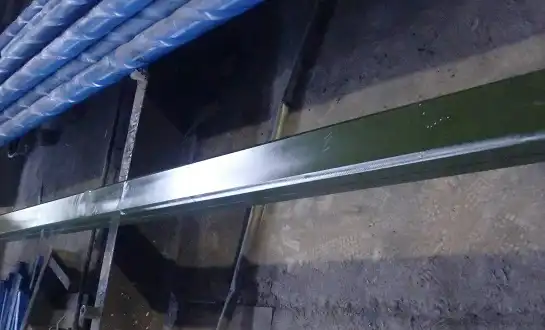
Critical Wear Points: What to Look For?
Square Kelly examination focuses on locations with mechanical contact, load transfer or connection stresses. The particular inspection points and acceptance criteria should be as per the relevant equipments technique and manufacturer regulations.
Corner Wear
The corners and drive surfaces of a Square Kelly are important areas to inspect because they interact with the kelly bushing during drilling.
Look for:
- Rounding or measurable loss of the drive surfaces
- Scoring, galling, or abnormal surface damage
- Localized wear patterns
- Cracks or other visible discontinuities
- Damage that may affect the fit or torque-transfer function
Normal wear should be assessed against the applicable dimensional or acceptance criteria rather than judged only by appearance. If wear appears excessive or uneven, the Square Kelly should be evaluated further before continued use.
Surface Cracks
Examine available surfaces for apparent fissures, abnormal indicators, corrosion damage, and other discontinuities.
Cracks or suspected cracks need special attention since the Square Kelly is exposed to mechanical loads several times during drilling operations. Visual examination can discover evident faults, but is not able to detect all beneath or surface breaking indications.
Where necessary, the inspection process should allow competent people to employ an appropriate non-destructive testing technique such as magnetic particle testing or liquid penetrant testing. The chosen technique should be appropriate for the material, kind of fault and the purpose of the inspection.
Dimensional Changes
Dimensional inspection is useful when evaluating wear on the Square Kelly's drive surfaces and body.
Depending on the equipment design and inspection procedure, measurements may include:
- Cross-sectional dimensions
- Across-flats dimensions
- Localized wear at the drive surfaces
- Other dimensions specified by the applicable acceptance criteria
When dimensional wear is an issue, don't depend on visual assessment alone. Measure with appropriate equipment and compare to manufacturer’s specifications or relevant inspection criteria.
A change in size is substantial if it impacts the intended fit, torque transmission, structural integrity or other established acceptance criteria.
Connection Threads
The threaded connections at the ends of the Square Kelly should also be inspected for damage and abnormal wear.
Look for:
- Damaged or deformed threads
- Galling
- Corrosion
- Excessive wear
- Contamination
- Evidence of improper make-up or break-out
Thread condition is critical because broken threads might hinder effective assembly and load transmission. Inspection and gaging of threads should be carried out by appropriate connection specification and inspection technique and not merely by eye examination.
API has distinct standards for the elements of a rotary drill stem and for the threading and gaging of the rotary shouldered connections, therefore the relevant requirement should be recognized for the individual equipment and connection.
Choosing the Right Lubricants for Optimal Performance
Lubrication should be considered part of the equipment maintenance method and not a general “grease everything” phase.
The proper product relies on the component, the connection, the working circumstances, the temperature, the exposure to contaminants and the manufacturer's specifications. Thread compounds and lubricants should be suitable with the surfaces and materials being protected as well.
High-Temperature Grease
Where grease lubrication is requested for a particular component or contact area the chosen product should be acceptable for the predicted operating temperature, load and environmental conditions.
Don’t assume all exterior contact surfaces to be greased the same for a Square Kelly. Lubricate areas requiring lubrication in accordance with the equipment manufacturer's lubrication recommendations and appropriate maintenance process.
Lubrication may be for reduction of friction, protection of appropriate surfaces and assistance of the desired service condition of the equipment. Too much lubricant may also accumulate drilling debris, therefore application should be managed rather than excessive.
Anti-Seize Compounds
If threaded connections are necessary, thread compounds or anti-seize products may be utilized.
The compound must be compatible with the connection and shall be applied in accordance with the suitable process. Using too much product or the inappropriate product might harm the connection make-up or thread condition.
Before applying a fresh compound, clean the joint well to eliminate any pollution and examine the threads for damage. Galling, deformation or other abnormal circumstances of the connection must not be considered a replacement for examination or repair by means of lubrication.
Corrosion Inhibitors
Corrosion protection might be required when a Square Kelly is exposed to damp, corrosive fluids, storage conditions or other circumstances conducive to corrosion.
The choice of corrosion-control products should be based on the condition of the equipment and anticipated use. Where applicable, operational lubrication and corrosion prevention during storage should be considered independent maintenance issues.
If visible corrosion is present, it should be investigated, not only covered with a protective substance. If corrosion has led to detectable material loss, pitting, cracking, or other damage, additional assessment could be necessary.
Environmentally Friendly Options
Where environmental regulations are relevant operators may consider lubricants or corrosion prevention products developed for the appropriate environmental conditions.
But it should not be the primary factor for selection of appropriateness for the environment. The product should also be suitable for the application, materials, temperature range, load circumstances and equipment method.
Therefore, the best lubricant is not always the most ecologically advertised product or the highest temperature product. It is the product that fulfills equipment and operational criteria and is also compliant with appropriate environmental regulations.
Maintenance Schedule: Balancing Frequency and Effectiveness
Maintenance schedule for a Square Kelly should take into account the state of equipment, working circumstances, manufacturer instructions, appropriate inspection processes and repercussions of equipment failure.
And every Square Kelly should not be shown as a universal need for every daily, weekly, monthly, quarterly or yearly interval. If equipment is subject to extreme working circumstances, unusual wear, impact, corrosion or other reasons, the inspection interval may need to be adjusted.
Daily Inspections
Before or during routine operations, personnel can perform appropriate visual checks for obvious damage, abnormal wear, contamination, or other changes in equipment condition.
Depending on the site procedure, this may include checking:
- Accessible drive surfaces
- Visible body condition
- Thread areas when accessible
- Signs of abnormal wear or damage
- General condition of the equipment
If a significant defect or unusual change is identified, the equipment should be evaluated according to the applicable site and inspection procedure rather than simply returned to service.
Weekly Lubrication
Lubrication should be according to the manufacturer’s recommendations and the actual working conditions, not a blanket weekly requirement.
If regular lubrication is requested, examine the surfaces before adding fresh oil. Remove contaminants where applicable and apply the right substance in the right quantity.
Demanding operating conditions may need more regular care. Over-lubrication may cause contamination or housekeeping concerns.
Monthly Thorough Inspection
A more detailed inspection should be performed at an interval appropriate for the equipment and operating conditions.
This inspection may include:
- Detailed visual examination
- Dimensional checks where required
- Thread inspection
- Review of wear patterns
- Cleaning of relevant surfaces
- Non-destructive testing when required by the inspection procedure
The objective is to identify changes that may not be apparent during routine visual checks.
Quarterly Overhaul
It is not a general requirement that every Square Kelly undergo a quarterly revision.
The decision to repair, dismantle or perform a more complete examination should be taken based on the condition of the equipment, inspection results, manufacturer recommendations, maintenance practices and relevant acceptance criteria.
Where an examination reveals excessive wear, cracking, damage to connections, corrosion or other issues beyond the permitted range, the Square Kelly should be taken out of service or otherwise disposed of as specified in the corresponding process.
Annual Certification
There’s no general ground to say every Square Kelly has to get third party verification once a year.
The inspection and certification requirements are often a function of the equipment, the operational organization, the jurisdiction, the customer needs, and the appropriate standards or processes. API presently recognizes API RP 7L for inspection, maintenance, repair and remanufacture of drilling equipment and API RP 7G-2 for inspection and classification of used drill stem parts.
c. Use competent individuals. Follow the relevant program if third party inspection, certification, or formal inspection documentation is necessary.
Conclusion
It takes more than basic cleaning and lubrication to keep a Square Kelly in top shape. A good maintenance schedule includes visual inspection, dimensional checks when needed, connection inspection, proper lubrication and additional inspection when abnormal circumstances are encountered.
The most critical locations to evaluate are the drive surfaces and corners, body surfaces, threaded connections and any region that shows abnormal wear or corrosion. If there is a suspected crack or other flaw that needs further study , you may use non-destructive testing to get more information .
Lubrication also has to be suited to the application. Thread compounds, grease and corrosion protection products should be chosen according on equipment design, operating environment, material compatibility and manufacturer or inspection requirements.
Finally, maintenance intervals should be determined by equipment condition and specific operations, not by rigid, uniform plans. Inspection records and documentation of substantial wear or damage may also assist maintenance teams in making more informed choices regarding ongoing operation, repair or replacement.
Call to Action
Welong supplies oilfield drilling equipment and can discuss Square Kelly requirements based on the intended drilling application and equipment specifications.
When requesting information about a Square Kelly, useful details may include:
- Required size and connection information
- Drilling application
- Operating environment
- Inspection or documentation requirements
- Known wear or maintenance concerns
- Applicable customer or project specifications
Providing this information can help make the product discussion more specific and reduce the risk of selecting equipment that does not match the intended application.
Contact Welong at oiltools15@welongpost.com to discuss your Square Kelly requirements or maintenance-related questions.