How to Reduce Web Wrinkles With a Precision Guide Roll
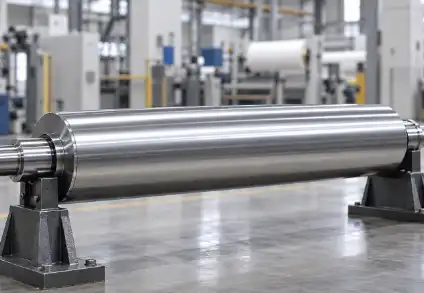
A web wrinkle is one of the most costly flaws in any converting process, generally occurring just after coating, laminating, or printing when the web value is already high. But the reason is nearly always something that occurred far earlier in the process. The guiding roll that is frequently disregarded has a disproportionate effect on whether or not creases occur at all. Web alignment is provided by a precise guide roll which distributes stress uniformly throughout the breadth and provides a steady entry angle into the next operation. This article shows how a well-built guide roll may help decrease web wrinkles, and what purchasers should look for when ordering a guide roll.
How Does Guide Roll Alignment Prevent Wrinkles During Web Handling?
Misalignment as the Root Cause of Wrinkles
If a guide roll is not parallel to adjacent rolls, the web is forced to vary width as it passes through. One side expands more than the other, and the imbalance soon shows up as cross-web wrinkles, edge waves, or flabby centers. Operators pursuing wrinkle issues generally concentrate on tension settings, but if the upstream guide roll is wrong, no amount of tension tweaking can correct the underlying geometry problem. The first place to start is thus to correct the guide roll alignment.
Parallelism Between Adjacent Rolls
The most critical alignment challenge is to ensure that the guide roll is parallel to the roll immediately downstream. This may be confirmed using a laser alignment tool or precision level. The aim is to have the guide roll within the alignment tolerance provided for the line. Many factories establish this tolerance depending on web width and desired line speed. When the guide roll is parallel, the web enters the next step at a constant angle throughout the whole width, which greatly decreases the circumstances that generate buckles and creases.
Skew, Tilt, and Their Effects on the Web
Another frequent cause of wrinkles is skew, when the axis of the guide roll is turned significantly in relation to the direction of the web. Even a slight skew angle forces the web to one side and generates unequal stress distribution. Tilt, with the guiding roll not level, has a comparable impact on how gravity and tension interact at the roll. The installation of a precision guide roll takes into consideration both skew and tilt, and up-to-date mounting gear provides for repeatable accuracy in terms of adjusting and locking down these parameters.
Guide Roll Geometry for Stable Web Tracking and Uniform Cross-Web Tension
Barrel Geometry and Crown Profile
The shape of the guide roll barrel (cylindrical) is essential for uniform cross-web tension. A designed guide roll is supplied with a regulated crown, and in certain cases, a very tiny taper to counteract the propensity for the roll to deflect at the center of the load. Without this crown, the web pressure is greater on the edges than in the middle of the web, and this might cause tracking drift and wrinkles at the edges. Those manufacturers that grind the guide roll to a precise profile are giving the line a considerably better starting point for tension uniformity.
Neck and Bearing Geometry
The roll necks, journals, and bearing seats must be machined to precise tolerances, since they support the whole barrel. Any eccentricity or geometrical inaccuracy of the guide roll journals causes a direct lateral movement of the web. Accurate bearing arrangements, well-fitted pillow blocks, and rigid side frames make the guide roll stable even with fluctuating web stress. The combination of precise barrel geometry and solid bearing geometry is what enables the line to maintain constant cross-web tension hour after hour.
Edge Effects and Trim Width Planning
If the guide roll is not constructed with the trim plan in mind, the edge effects are worse. If the web is to be trimmed at a certain width, the guide roll should be sized such that the active wrap zone is well inside the trim width. This prevents the untrimmed edge from controlling the way the web rides on the roll. The buyers that engage the guide roll provider early in the trim width planning phase always get better tracking and less wrinkling, as the roll shape is suited to the actual web width the line will run.
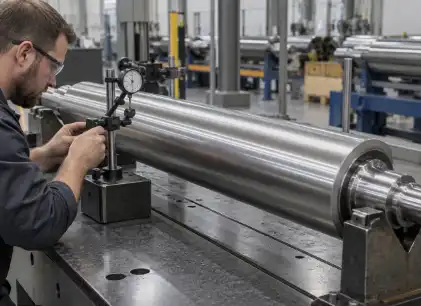
How Do Guide Roll Surface Finish and Web-to-Roll Friction Affect Wrinkle Formation?
Surface Finish and Its Effect on the Web
The surface quality of the roll determines the slip and grip characteristics of the web in the contact zone. A highly polished guide roll enables the web to move with little friction. Suitable for films and foils when traction is not required. A guide roll, whether rougher or elastomer-covered, gives paper, nonwoven, and textile webs the traction needed to approach a downstream nip or coating station with predictable tension. Choosing the correct finish for the application is one of the simplest methods to regulate cross-web tension and to minimize wrinkles.
Coefficient of Friction and Tension Distribution
The friction between the guide roll and the web governs the build-up of tension throughout the contact zone. Too little friction will cause the web to slide, and the tension will be unequal throughout the breadth. If the friction is too great, the web might be stretched unevenly as it exits the roll, causing creases immediately downstream. The guide roll may be specified to the correct surface roughness or elastomer hardness so that the line can function in the friction range which will provide consistent cross-web tension without web distortion.
Cleanliness, Coatings, and Static Behavior
Surface condition, as well as friction, is another factor in how the web rides on the roll. Contamination, rubber marking, and static accumulation all influence web behavior at the guide roll. On film and nonwoven lines, where the web is attracted to the roll due to static electricity, causing creases at the edges, anti-static or static-dissipative coatings are helpful. Contamination-resistant coatings increase the duration between roll changes and let the line operate for longer periods of time with constant web quality.
Buyers considering these features will find that standardized material and surface testing methods are documented across ASTM International standards, which cover many of the surface roughness and adhesion tests used to qualify guide roll coatings.
Guide Roll Diameter and Wrap Angle for Smoother Web Contact
Diameter and Its Effect on Wrap Geometry
The wrap angle for a given shape is less with a larger guide roll diameter and therefore minimizes the bending tension at the web edges. Larger diameter guide rollers are especially advantageous for thin films and lightweight nonwovens, as they are less compressed and less likely to wrinkle as they move around the roll. The larger diameter also minimizes the possibility of slide on sticky or coated webs, since greater contact length is available to produce friction. So, one of the first considerations a buyer of a guide roll should make is to choose the proper diameter.
Wrap Angle and Tension Build-Up
The wrap angle is very much connected to the diameter and controls how much friction the guide roll may cause. Increasing the wrap angle increases the arc of contact between the web and the roll, allowing more tension to be transmitted without slip. In the case of steady tension build-up, many guide rolls with regulated wrap angles are commonly employed in combination. This gradual tension build-up is easier on the site and needs fewer wrinkles than trying to develop all the tension in one nip.
Contact Length and Edge Pressure
Contact length on the guide roll should be adequate to hold the whole web width without edge effects. When the contact length is too short, the margins of the web are under more unit pressure than the center, producing the characteristic saggy center or tight edges wrinkle pattern. The precise guide roll is built with a contact length equal to the specified web width and tension profile. This is a design feature that is easy to ignore, but one that pays back repeatedly in fewer creases and less trash.
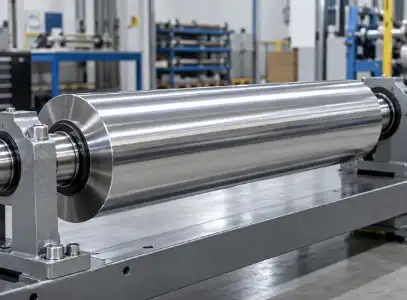
How Does Precision Guide Roll Design Improve Wrinkle Control at High Web Speeds?
Dynamic Balance and Vibration Control
A slight mass imbalance in the guide roll causes vibration at high web speeds that translates into oscillating tension and edge movement. Vibration-induced wrinkles are especially hard to identify since they are intermittent and only occur at specific rates. Precision dynamic balancing, often to ISO 1940 G1.0 or higher, eliminates the mass eccentricity that causes these difficulties. The completed body is balanced by bearings on a precise guide roll, and when the roll is mounted in the line, the balance is maintained.
Critical Speed and Structural Stiffness
All guide rolls have a natural critical speed at which they resonate. This high-speed operation causes large-amplitude vibration, which is a certain generator of wrinkles. The design of precision guide rolls is such that the working speed is substantially below the critical speed by choosing suitable diameters, wall thicknesses, and journal widths. This is supported by the structural rigidity of the side frames and bearing housings. So the guide roll is in its quiet working range even with fast acceleration and deceleration of the line.
Bearings, Lubrication, and Thermal Stability
Smooth operation of a guide roll at speed is affected by bearings and lubrication. Both runout and heat caused by worn or improperly greased bearings are detrimental to web quality. Precision guide rollers are fitted with high-quality bearings with regulated internal clearances. These bearings are available as sealed units or greased-for-life bearings to provide constant performance over lengthy campaigns. Thermal stability is important as well because heat generated in the bearing housing might go into the barrel and modify the crown shape significantly. The design of a well-engineered guide roll takes into consideration the temperature impacts so that the web perceives a solid surface during the run.
Integration with Tension Control and Steering Systems
A precise guide roll is not a stand-alone device. It connects with the line’s automated tension management, edge guide, and steering systems. When the guide roll is balanced and correctly aligned, these systems may be operated with a stiff guide roll at their specified gain and response levels. If the guiding roll is unsteady, the control systems are detuned and their influence reduced, leaving wrinkles for the operators to pursue. So, a precise guide roll design investment enhances the performance of every other web handling component on the line.
Conclusion
One of the most effective tools a converter has for minimizing web wrinkles is a precision guide roll, since it tackles the alignment, geometry, surface smoothness, diameter, and dynamic stability that decide whether the web remains flat as it travels. Buyers that intentionally request these characteristics, instead of taking generic catalog rolls, will notice substantial gains in wrinkle control, scrap rates, and line uptime. In contemporary conversion, the guide roll is no longer a passive support but a precise element silently dictating the quality of everything downstream.
FAQ
1. What is the most common cause of web wrinkles in a converting line?
The most common cause is misalignment of the guide roll or of the rolls around it. Even small alignment errors produce uneven cross-web tension, which quickly shows up as wrinkles, baggy centers, or tight edges. Alignment should always be checked before adjusting tension or other process parameters.
2. Does a larger diameter guide roll always reduce wrinkles?
A larger diameter reduces bending stress at the web edges and is usually better for thin films and lightweight nonwovens, but the best diameter always depends on the web type, line speed, and available space. The right diameter is the one that matches the geometry and tension profile of the specific line.
3. How often should guide rolls be inspected for surface condition?
Inspection frequency depends on the web and line speed, but most plants benefit from a quick visual inspection during every shift change and a more detailed surface measurement at planned maintenance intervals. Coated or elastomer-covered guide rolls should be checked more often because their surface changes gradually as they wear.
Source Precision Guide Rolls With WELONG
When your converting line needs guide rolls that deliver stable web handling and consistent wrinkle control, WELONG is ready to help. Founded in 2001 and certified to ISO 9001:2015 and API 7-1, WELONG is an international integrated supply chain service provider specializing in oilfield products and customized industrial solutions. The company supplies engineered components with strict quality control covering chemical composition inspection, dimensional inspection, dynamic balance testing, ultrasonic testing, and visual inspection. With flexible transport options including sea, air, and rail, and terms such as FOB, CIF, DDP, and DDU, WELONG makes procurement straightforward for converters worldwide. Reach the team today at [email protected] to discuss your guide roll requirements.
References
1. ISO 1940-1:2003, Mechanical vibration — Balance quality requirements for rotors in a constant (rigid) state — Part 1: Specification and verification of balance tolerances. International Organization for Standardization, Geneva.
2. ISO 4287:1997, Geometrical Product Specifications (GPS) — Surface texture: Profile method — Terms, definitions and surface texture parameters. International Organization for Standardization, Geneva.
3. ISO 9001:2015, Quality management systems — Requirements. International Organization for Standardization, Geneva.
4. ASTM D4060-19, Standard Test Method for Abrasion Resistance of Organic Coatings by the Taber Abraser. ASTM International, West Conshohocken.
5. Bolton, W., Industrial Automation: Hands-On Tutorials for Engineers and Technicians. Newnes, Oxford.
6. Passewitz, G., Web Handling and Converting: A Practical Guide for Producers and Converters. TAPPI Press, Atlanta.
Share your inquiry, get the quotation accordingly!

CHINA WELONG - 20+ years manufactuer in oilfield tools