BOP Hose vs Choke Hose: Key Differences for Oilfields
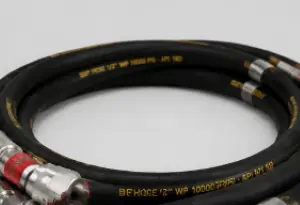
On any drilling rig, two very different hoses quietly share the responsibility of well control. The BOP hose carries hydraulic power that closes the blowout preventer in seconds, while the choke hose carries dangerous formation fluids away from the well to be safely bled down. Confusing the two—or specifying one where the other belongs—compromises the entire well control system, so buyers and rig supervisors need a clear picture of how they differ. With sizes from 1/2" to 1-1/2", working pressures up to 10,000 psi, and fire-resistant construction in stainless steel armor or high-molecular polymer designs, the modern BOP hose is a precision safety component in its own right. This guide explains the differences that matter.
What Is the Difference Between BOP Hose and Choke Hose in Oilfield Systems?
Different Fluids for Different Missions
The cleanest way to separate these two hoses is by what flows inside them. A BOP hose transports hydraulic control fluid—essentially clean oil under pressure—from the accumulator unit to the preventer's operating cylinders, transmitting energy rather than well fluids. A choke hose does the opposite job, carrying mud, gas, and formation fluids returning from the wellbore toward the choke manifold. Because a BOP hose handles a clean, stable medium, its design prioritizes pressure integrity and fire survival rather than the erosion resistance that defines flowline equipment on the choke side.
Connection Points in the Well Control Layout
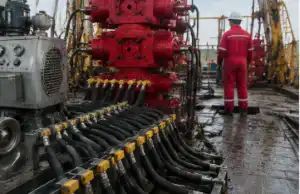
Placement follows function. The BOP hose forms the link between the rig's accumulator and every hydraulic function on the BOP stack—ram operators, the annular preventer, and hydraulically actuated valves—running in organized bundles along the substructure. The choke hose connects the BOP's side outlet to the choke manifold, forming part of the pressure-containing flow path for well fluids. One system powers the barrier; the other carries what the barrier holds back. Recognizing this division helps buyers specify each BOP hose and flowline correctly for its actual service.
Governing Standards and Test Regimes
Each hose answers to different engineering standards. A BOP hose intended for control systems is qualified under API 16D requirements, which include flame exposure testing that proves the hose maintains pressure and function when engulfed in fire—a survival requirement unique to safety-critical control lines. Choke and kill line hoses fall under API 16C and related flowline specifications, where erosion, gas permeation, and pulsation resistance dominate the test agenda. Buyers reviewing certificates should confirm that a BOP hose carries genuine fire-test qualification, not merely a pressure rating on a datasheet.
How Do BOP Hose and Choke Hose Perform Different Roles in Pressure Control Operations?
Delivering Instant Hydraulic Power
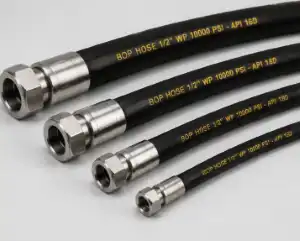
When the driller hits the BOP control, response time is measured in seconds, and the BOP hose is what makes that response possible. Charged with accumulator pressure at up to 5,000 psi—and rated far higher, up to 10,000 psi in working pressure for the hose itself—it transmits closing force to the ram operators immediately and completely. Every BOP hose in the control bundle must hold that readiness for months at a time, standing pressurized and waiting for a moment everyone hopes never arrives but must always be prepared for.
Carrying the Kick Away From the Well
The choke hose performs its service after the barrier has closed. With the BOP shut, formation fluids flow through the choke hose toward the manifold, where adjustable chokes bleed pressure down under control. This is violent duty: high-velocity, gas-cutting, solids-laden flow that punishes every internal surface. Where a BOP hose is judged on reliability during long standby and instant actuation, the choke hose is judged on surviving continuous erosive flow at full rated pressure—two fundamentally different definitions of performance within the same well control event.
Standby Readiness vs Active Flow Duty
Thinking in duty cycles clarifies procurement priorities. A BOP hose spends nearly all its life pressurized but static, so aging resistance, fitting integrity, and fire survival dominate its specification. Choke and kill hoses cycle between idle and severe flowing service, making bore liner quality and end-connection reinforcement the critical features. Neither role is more important than the other—they are simply different, and a rig that understands the distinction inspects, tests, and replaces each hose type on criteria matched to how that BOP hose or flowline actually works.
BOP Hose vs Choke Hose: Comparing Structure, Function, and Application Areas
Armor and Polymer Construction Options
Structural choice is where the BOP hose shows its engineering pedigree. The stainless steel armor type wraps the reinforced hose core in a metallic sheath that provides outstanding fire resistance, heat insulation, and mechanical protection, while the high-molecular polymer type achieves flame resistance through advanced synthetic outer layers with lighter weight and easier routing. Material selection for armored constructions can be benchmarked against data from the National Science Data Center for Corrosion and Protection of Materials, helping buyers match sheath metallurgy to marine or corrosive atmospheres for long service life.
Pressure and Temperature Envelopes
The envelopes and the design philosophies become obvious. A BOP hose in the 1/2" to 1-1/2" size range handles working pressures up to 10,000 psi—or customized ratings beyond that—across a temperature span from -40°C to +121°C, covering arctic land rigs to hot desert and geothermal-adjacent operations. Choke hoses trade that compact, high-pressure control profile for larger bores that pass formation fluids at volume. Specifying a BOP hose with the full temperature range ensures the hydraulic control system responds identically whether the rig works in Siberia or the Sahara.
Where Each Hose Earns Its Place
Application mapping keeps purchasing honest. The BOP hose belongs on control circuits: accumulator-to-stack runs, remote panel connections, and hydraulic valve actuation lines where fire resistance and heat insulation are mandatory. Its rated performance in high-temperature and flammable environments has even carried it into hydraulic transmission duty in the metallurgical industry, where furnaces create similar hazards. Choke hoses belong exclusively in the well-fluid flow path. Assigning each BOP hose and flowline to its designed service is the simplest way to preserve the integrity of both systems over years of operation.
Which Oilfield Operations Require BOP Hose Instead of Choke Hose?
Hydraulic Control Hookups on Every Rig
Any operation that closes a BOP hydraulically—which is to say, virtually every drilling and workover rig—depends on the BOP hose. Land rigs, jack-ups, and platform installations all run control bundles from the accumulator to the stack, and each line in that bundle must meet the same fire-rated, high-pressure specification. Well service and snubbing units with hydraulic preventers need the same discipline on a smaller scale. Wherever hydraulic energy must reach a safety device reliably, the BOP hose is the only correct choice for the connection.
Fire-Risk and High-Temperature Zones
Certain locations raise the stakes further. Rigs drilling high-pressure gas, operations near production facilities, and sites where hydrocarbon release could ignite all demand the fire resistance built into every quality BOP hose. The flame-test qualification behind that rating ensures the crew can still close the preventer even while a fire burns nearby—buying the seconds that separate a controlled shut-in from an escalation. No ordinary hydraulic hose, regardless of pressure rating, substitutes for a BOP hose in these zones, because pressure capacity without fire survival fails precisely when it is needed most.
Industrial Duty Beyond the Drilling Rig
The same qualities that protect rigs serve other industries facing heat and flame. Hydraulic transmission in the metallurgical industry, where lines run near molten metal and open flame, calls for exactly the fire resistance and heat insulation the BOP hose provides. Buyers supplying steel plants and foundries increasingly specify these oilfield-grade hoses for critical hydraulic circuits. This crossover demand confirms the design's fundamental soundness: when a BOP hose survives rig fires and furnace halls alike, its engineering pedigree speaks for itself across any high-temperature, flammable working environment.
Understanding How BOP Hose and Choke Hose Work Together in Drilling Systems
The Sequence of a Well Control Response
Watch a well control event unfold, and the partnership becomes clear. First, the BOP hose delivers the hydraulic force that closes the preventer and traps the kick underground. Then the choke hose takes over, carrying the trapped influx to the manifold where pressure is bled away while kill mud circulates. The two hoses work in sequence within a single coordinated response—one closing the door, the other draining the danger behind it. A drilling system is only as strong as this handoff, which is why the BOP hose and choke hose are planned, installed, and tested as one system.
Routing, Bend Radius, and Installation Discipline
System reliability is decided as much by installation as by manufacture. Each BOP hose should be routed with generous bend radii, protected from sharp edges and dropped-object zones, and secured so vibration cannot chafe the outer cover against steelwork. Choke hoses need straight, well-supported runs that minimize flow-induced movement. Crews should verify end fittings are torqued correctly and that control bundles remain clearly identified for emergency tracing. Good routing practice costs nothing but attention, and it preserves the engineered performance of every BOP hose through years of rig moves and daily vibration.
One Quality Standard Across Both Lines
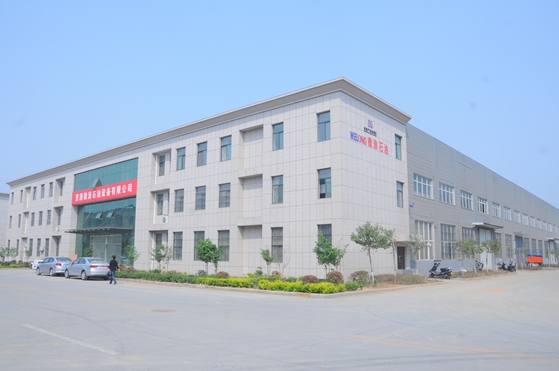
Although their duties differ, both hoses deserve identical procurement rigor. Source from manufacturers certified to ISO 9001:2015 and API 7-1, whose quality systems govern hose assembly, crimping, and pressure testing from end to end. WELONG, with over 20 years of oilfield manufacturing experience, applies strict in-process and final inspection to every BOP hose it ships, and offers third-party verification through SGS or DNV for buyers requiring independent confirmation. When both your control lines and flowlines arrive with complete test documentation from one accountable supplier, system integrity stops being an assumption and becomes a record.
Conclusion
The BOP hose and choke hose share a mission but never a job description. One transmits hydraulic power to close the preventer, standing pressurized and fire-ready for months; the other carries the kicked fluids away under erosive, high-pressure flow. Their structures, standards, sizes, and duty cycles differ accordingly—and so should their specifications, inspections, and replacement criteria. Buyers who match each hose to its true role, insist on fire-tested API 16D qualification for control lines, and source both from certified manufacturers build well control systems that respond flawlessly when seconds matter. Specify each line for the job it actually does, and drill with confidence.
FAQ
Q1: What sizes and pressure ratings are available for a BOP hose?
Standard BOP hose sizes range from 1/2" up to 1-1/2", covering accumulator-to-stack control lines and hydraulic valve connections. Working pressures reach up to 10,000 psi, with customized ratings available for special applications, and the operating temperature range spans -40°C to +121°C. Both stainless steel armor and high-molecular polymer construction types are offered to suit different fire-resistance and routing requirements.
Q2: Why does a BOP hose need fire resistance?
Well control events can involve ignition, and the hydraulic control system must remain functional even when exposed to flame. Fire-resistant BOP hose constructions—qualified through flame exposure testing—maintain pressure and actuation capability long enough for crews to close the preventer during a fire. This survival capability is what distinguishes a true BOP control hose from an ordinary high-pressure hydraulic line.
Q3: Can a BOP hose be used in a choke or kill flowline?
No—each hose is engineered for a distinct duty. A BOP hose is built for clean hydraulic fluid, standby pressure, and fire survival, while choke and kill hoses are built with large bores and erosion-resistant liners for well fluids. Using control hose in a flowline, or vice versa, compromises safety. Always apply each hose strictly within its rated and certified service.
Source Fire-Rated BOP Hoses From WELONG
Need BOP hose assemblies built for the demands of real well control? Founded in 2001, China WELONG is a professional international supply chain service provider specializing in oilfield products and customized solutions, certified to ISO 9001:2015 and API 7-1. Our BOP hoses—available from 1/2" to 1-1/2" in stainless steel armor and high-molecular polymer types, rated up to 10,000 psi and -40°C to +121°C with fire resistance and heat insulation—are manufactured under strict quality control, with SGS and DNV third-party inspection available. With sea, air, and railway transport and terms from FOB to DDP, we deliver on schedule, worldwide. Contact us today at oiltools@welongpost.com for a tailored quotation and expert support.
References
1. American Petroleum Institute. API Specification 16D: Control Systems for Drilling Well Control Equipment and Control Systems for Diverter Equipment, 3rd Edition. API Publishing, 2018.
2. American Petroleum Institute. API Specification 16C: Choke and Kill Equipment, 2nd Edition. API Publishing, 2015.
3. American Petroleum Institute. API Specification 7K: Drilling and Well Servicing Equipment, 6th Edition. API Publishing, 2015.
4. Grace, Robert D. Blowout and Well Control Handbook, 2nd Edition. Gulf Professional Publishing, 2017.
5. International Association of Drilling Contractors. IADC Drilling Manual, 12th Edition. IADC, 2015.
6. Lyons, William C., and Gary J. Plisga. Standard Handbook of Petroleum and Natural Gas Engineering, 2nd Edition. Gulf Professional Publishing, 2005.
Share your inquiry, get the quotation accordingly!
CHINA WELONG - 20+ years manufactuer in oilfield tools