Tension Roll: What It Is and How It Controls Web Tension
Web tension is the unseen factor that determines whether a conversion line makes a salable product or costly scrap. The tension roll, which is found in almost every continuous web activity, is the component that keeps this variable inside its desired window. Yet the tension roll is commonly considered simply another idler, when in fact it is a mechanically defined part with precise control that determines how the web behaves between unwind, process, and rewind. This article describes a tension roll, how it manages web tension, and what customers should know when ordering a tension roll.
What Is a Tension Roll and How Does It Maintain Stable Web Tension?
Definition and Core Function
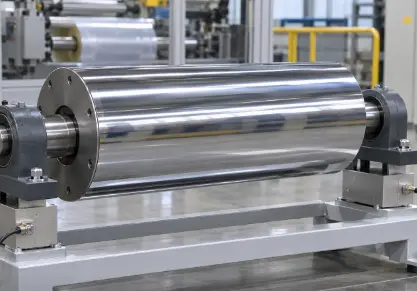
A tension roll is a roll in the web route whose main function is to produce, measure, or control tension in the moving web. Unlike a work roll powered by a motor or a support roll, the tension roll normally has a minimum driving torque of its own. It kind of interfaces with the web via friction, wrap, and occasionally by an applied load or position instruction. The tension roll is the reference point where the remainder of the line can maintain a steady web tension throughout the operation.
Tension as a Closed-Loop Variable
Modern lines consider tension a closed-loop variable. This variable is monitored or regulated at the site called the tension roll. The tension roll goes up and down to absorb excess or deficiency of web, and its location is transmitted back to the driving system in a dancer-based system. In a load-cell based system, the tension roll is installed on a force transducer that directly monitors web tension. In both situations, the tension roll’s sensing element transforms an abstract process variable into a meaningful signal.
Why Stable Tension Improves Product Quality
Stable tension immediately enhances flatness, coating consistency, gage control, and winding quality. Small changes in tension may create obvious flaws in films and foils such as flabby centers, tight edges, or gage banding. A high-precision tension roll that maintains its setpoint is one of the most cost-effective tools a converter has to improve product quality and save waste because it targets the underlying cause of many frequent problems before they can develop.
Tension Roll Force and Web Wrap for Consistent Material Transport
Force Application Through Wrap Geometry
The wrap angle the web produces around a tension roll creates force on the web. A larger wrap angle creates more contact arc, and more friction may thus build up between the web and the roll surface. This friction is what permits the tension roll to apply or absorb tension without slippage. Engineers choose wrap shape carefully so that the tension roll can deal with the worst-case tension and speed combination without losing traction.
Applied Loads and Brake or Motor Force
Some tension rollers use pneumatic, hydraulic, or spring cylinders to provide a regulated normal force against the web. The applied load influences the friction at the roll surface and hence the maximum tension the roll can create or absorb. In unwind applications, the brake, which releases energy as heat, may be applied to the tension roll. In winder applications, the tension roll may be motor-powered, adding energy to the web. The roll is the mechanical interaction between the energy source and the web in both circumstances.
Surface Friction and Material Selection
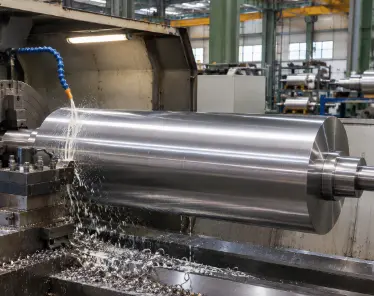
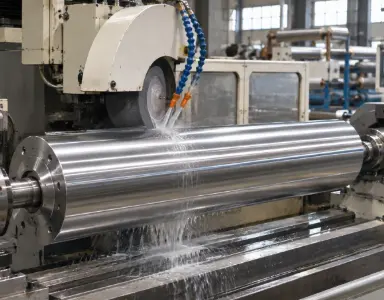
The coefficient of friction of the web must be correct for the tension roll surface. Films and foils often travel across smooth, hard surfaces such as chrome-plated steel or aluminum. Elastomer covers are used for paper, nonwoven, and textile webs to prevent sliding without marking. Pick the incorrect surface, and you instantly lose tension control. The surface material of the tension roll should be specified by buyers with the same attention as other roll requirements.
How Does a Tension Roll Respond to Changes in Web Speed and Tension?
Response to Speed Changes
If the line speeds up or slows down, the tension roll has to react rapidly enough to retain tension within its desired band. A dancer system tension roll is an almost rapid response; the dancer simply moves to take up the changed web length. For a tension roll on a load cell, the drive system should have a fast torque change to keep the tension constant. The mechanical inertia of the tension roll limits its ability to follow speed variations notably during the unwind or rewind when roll diameters vary.
Response to Tension Disturbances
Tension disturbances are caused by a variety of factors such as eccentricity of the upstream rolls, splice transitions at the unwind, variation in web thickness coming in, changes in process conditions such as dryer draw or coating pickup. The tension roll is the mechanism that absorbs these disturbances before they are propagated downstream. A tension roll with the right characteristic of response minimizes these disturbances so that they are minor, easily controllable signals which the drive system can fix instead of developing into noticeable flaws.
Tuning and Control Loop Behavior
Tension roll is part of a control loop. Loop tuning impacts how effectively the system reacts to disturbances. A sluggish loop allows significant excursions of tension to develop; an aggressive loop causes oscillation and instability. There is always a tradeoff in tuning, but a carefully built tension roll provides the mechanical underpinning for reliable tuning. Its stiffness, damping, and inertia are predictable, which makes it easy to adjust controller gains to levels that function in practice.
Tension Roll Feedback Systems: Dancer Position, Load Cells, and Drive Control
Dancer Position as a Feedback Signal
A dancer is a tension roll attached to a pivoting or sliding carriage which travels up and down as the web length varies. The dancer position serves as the feedback signal, informing the driving system whether to apply or remove torque. Dancers are basic, sturdy, and forgiving. That’s why they’re still ubiquitous in many conveyor lines. The tension roll in a dancer system is generally lightly loaded and freely moving, and hence its bearings and pivots must have low friction for the system to function consistently.
Load Cells as a Direct Tension Signal
A load cell tension roll immediately measures the force applied by the web to the roll. The force is equal to the web tension times the shape of the wrap around the roll. The load cell signal is sent to the drive system, and the torque is adjusted to maintain the measured force equal to the setpoint. Load cell systems are rapid and reproducible and hence are ideal for high-speed lines and operations that need precise tension control.
Drive Systems Acting on Tension Roll Feedback
The driving system is ultimately controlled by both dancer and load cell feedback. The drive may be a brake, a clutch, or a torque-regulated motor. The tension roll is the mechanical interface that allows the drive to engage with the web in a regulated manner. When the drive, tension roll, and feedback element are built as a system, the outcome is tension management that is steady from thread-up, through maximum production speed, and back down to stop.
How Does Tension Roll Control Prevent Slackness, Stretching, and Web Breaks?
Preventing Slackness at Low Speed
Slackness is the most typical tension-related problem at low line speeds, during splices and line stops. Proper feedback control of a tension roll will avoid slackness by maintaining a minimum tension setpoint at all times, especially while idling or threading the line. Dancers are a very forgiving way to avoid slacking in that they can tolerate modest overages or shortages of web without requiring substantial drive modifications. A properly adjusted tension roll mechanism, then, maintains the web in tension from the time it is threaded.
Preventing Stretching at High Speed
The web stretches when the stress surpasses the elastic limit of the web or the amount that the downstream process can accept. Stretching is avoided by the tension roll, which maintains tension within a band that is commensurate with the web material and the operation. This is where load cell devices perform well, since they monitor tension immediately and promptly rectify excursions. This avoidance of stretching may preserve a meaningful percentage of yield in films, foils, and lightweight nonwovens throughout the life of a manufacturing run.
Preventing Breaks Through Stable Control
Web breaks are the most disruptive stress occurrence as they halt the line, create debris and may damage equipment. Most breakdowns start as tiny stress excursions that turn into major ones when the control system cannot keep up. The drive system has a tension roll which gives precise, low-noise feedback, so these excursions may be caught early before they become breaks. One of the most valuable benefits that a correctly constructed tension roll can give to a conversion line is the prevention of breakage via steady tension management.
Long-Term Stability and Maintenance
Tension roll performance is a function of mechanical stability over the life of the line. Tension control will slowly diminish because of wear of the bearings, drift in the load cell, or wear of the dancer pivots. Routine maintenance, calibration, and lubrication maintain the tension roll operating as specified. Buyers who plan a maintenance schedule around the tension roll’s critical components extend the useful life of the control system and maintain stable tension year after year, supported by ISO 9001:2015 certifications that set the baseline for documented process control.
Conclusion
The tension roll is the mechanical and control anchor of any web tension system. How force is delivered to the web, how tension is detected, and how disturbances are absorbed before they become faults is determined. Engineers and procurement teams who approach the tension roll as a precision component instead of a generic idler enjoy reliable tension management, greater yield, and fewer web breaks for the entire life of the line.
FAQ
1. What is the main function of a tension roll?
The main function of a tension roll is to develop, measure, or regulate web tension so that the line can transport the web without slackness, stretching, or breaks. It acts as the mechanical interface between the drive system and the web, and it provides the feedback signal that the controller uses to maintain the target tension.
2. How does a dancer tension roll differ from a load cell tension roll?
A dancer tension roll moves on a carriage and provides feedback based on its position, while a load cell tension roll stays fixed and provides feedback based on the force the web exerts on the roll. Dancers are forgiving and easy to tune, while load cells are fast, accurate, and well suited to high-speed lines.
3. What causes tension roll performance to degrade over time?
Common causes include bearing wear, load cell drift, dancer pivot friction, surface contamination, and elastomer hardening on covered rolls. Routine inspection and calibration, along with timely replacement of wear parts, keep the tension roll performing at its original specification throughout the life of the line.
Source Reliable Tension Rolls With WELONG
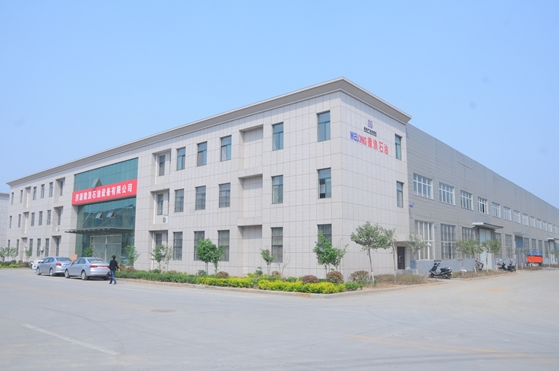
When your web handling line needs a tension roll that delivers stable, repeatable tension control, WELONG is ready to support you. Founded in 2001 and certified to ISO 9001:2015 and API 7-1, WELONG is an international integrated supply chain service provider specializing in oilfield products and customized industrial components. The company supplies engineered rolls with strict quality control covering chemical composition inspection, dimensional inspection, dynamic balance testing, ultrasonic testing, and visual inspection. With flexible transport options including sea, air, and rail, and terms such as FOB, CIF, DDP, and DDU, WELONG makes procurement straightforward for converters and mill builders worldwide. Reach the team today at [email protected] to discuss your tension roll requirements.
References
1. ISO 9001:2015, Quality management systems — Requirements. International Organization for Standardization, Geneva.
2. ASTM D4060-19, Standard Test Method for Abrasion Resistance of Organic Coatings by the Taber Abraser. ASTM International, West Conshohocken.
3. ASME B46.1, Surface Texture (Surface Roughness, Waviness, and Lay). American Society of Mechanical Engineers, New York.
4. Bolton, W., Industrial Automation: Hands-On Tutorials for Engineers and Technicians. Newnes, Oxford.
5. Passewitz, G., Web Handling and Converting: A Practical Guide for Producers and Converters. TAPPI Press, Atlanta.
6. Roisum, D. R., The Mechanics of Winding. TAPPI Press, Atlanta.
Share your inquiry, get the quotation accordingly!
CHINA WELONG - 20+ years manufactuer in oilfield tools