Wellhead Equipment vs Christmas Tree: Key Differences Explained
Visit any producing well site, and you will hear two titles all the time. They are wellhead equipment and the Christmas tree. They sit right on top of each other and act as a single pressure-containing system, so occasionally they get confused, even by those who work with wells every day. But they are separate assemblies, with different duties, time for installation, and varied priorities in their specifications. For buyers and engineers, mixing them together may lead to mismatched flanges, improper pressure ratings, and procurement delays. This article discusses the limits of wellhead equipment vs the Christmas tree, how they interface and what to look for when sourcing as a co-ordinated bundle.
What Is the Main Difference Between Wellhead Equipment and Christmas Tree?
Location in the Surface Stack
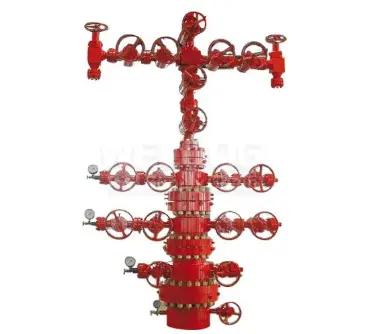
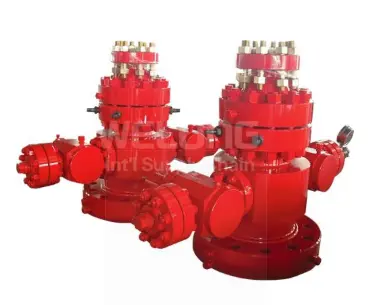
The clearest difference is physical position. Wellhead equipment forms the lower portion of the surface assembly, beginning with the casing head attached to the surface casing and building upward through casing spools to the tubing head. The Christmas tree bolts onto the tubing head's top flange and caps the entire stack. Everything below the tree's bottom connection belongs to the wellhead; everything above it belongs to the tree, creating a clean dividing line that engineers use when specifying, installing, and testing surface equipment.
Core Purpose: Support and Sealing vs Flow Control
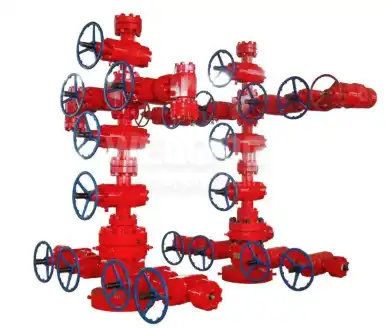
Wellhead equipment exists primarily to support weight and seal annular spaces—it suspends casing strings and the production tubing, anchors the blowout preventer during drilling, and isolates every annulus between concentric strings. The Christmas tree, by contrast, exists to manage flow: its master valves, wing valves, and choke regulate, direct, or shut in production. One assembly is the structural foundation of the well; the other is its control panel, and both are indispensable to safe operations.
Installation Timing Across the Well Lifecycle
The two arrive at different moments. Wellhead equipment is installed progressively during drilling—the casing head after surface casing is cemented, spools after each subsequent string, and the tubing head before completion begins. The Christmas tree appears only after the tubing string is run and the hanger is landed. In practical terms, wellhead equipment serves the drilling phase first and the production phase permanently, while the tree is purely a production-phase component installed at the very end of the completion sequence.
Wellhead Equipment and Christmas Tree: Different Roles in Oil and Gas Wells
Suspension and Load-Bearing Duties
Casing strings in a deep well can weigh hundreds of tons, and every bit of that load hangs in the wellhead equipment. Slips and mandrel hangers inside the casing head and spools transfer string weight safely into the surface casing, while the tubing hanger suspends the production string inside the tubing head. The tree carries no structural load beyond its own weight and flow forces. This load-bearing role is unique to the wellhead and drives its heavy forged construction and reinforced flanged connections.
Annular Sealing Responsibilities
Sealing duty is divided clearly between the two. Wellhead equipment seals the annular spaces—between each pair of casing strings and between the tubing and production casing—using packoffs and hanger seal assemblies rated for the well's pressure and fluid environment. The tree seals only the production bore flow path itself. Because annular integrity is a primary regulatory concern throughout a well's life, the sealing performance of wellhead equipment receives intense scrutiny during installation testing and periodic integrity verification programs.
Production Flow Management
Once hydrocarbons reach the surface, the Christmas tree takes over. Its valves open or shut the well, its choke trims flow rates to match facility capacity, and its outlets direct production toward flowlines, separators, or manifolds. Wellhead equipment supports this activity by providing the pressure-rated foundation and annular access points, but it does not throttle production. Understanding this division of labor helps buyers specify each assembly correctly instead of expecting one to perform the other's job.
How Do Wellhead Equipment Components Work Together With Christmas Trees?
The Flanged Interface at the Tubing Head Top
The tree meets the wellhead at a single critical connection: the tubing head top flange. Available in sizes from 7-1/16" to 13-5/8", this flange accepts the tree's bottom connection through studs, nuts, and a ring gasket that forms a metal-to-metal seal. Because this joint contains full well pressure directly above the tubing hanger, wellhead equipment manufacturers machine these flanges to strict tolerances, ensuring the tree lands, seals, and tests correctly the first time without field modification.
Matching Pressure Ratings and Material Classes
For the combined system to work safely, wellhead equipment and tree must share the same working pressure—anywhere from 2,000 to 15,000 psi—along with matching material classes from AA through FF and temperature classes such as PU or LU. A 10,000 psi tree mounted on a 5,000 psi tubing head would create an obvious weak point. Specifying identical Product Specification Levels, from PSL1 through PSL3G, keeps testing and documentation consistent across the entire stack from the outset.
Testing the Assembled System
After the tree is installed, the complete assembly is pressure-tested as one integrated barrier before the well is put on production. Wellhead equipment supports this process through built-in test ports that allow seals, hanger packoffs, and flange connections to be verified individually and collectively. Documentation aligned with API Spec 6A and PR1 performance verification gives operators a traceable record proving that every component—from the lowermost casing head to the tree's uppermost valve—performs exactly as rated.
Adapters and Crossover Flexibility
Real projects rarely match perfectly off the shelf, and crossover adapters bridge the gaps. These fittings connect dissimilar flange sizes or pressure ratings—for example, adapting a larger tubing head outlet to a more compact tree configuration. Wellhead equipment specified with adaptable connections allows future tree replacements or upgrades during workovers without machining or welding at the wellsite, preserving flexibility across decades of changing production strategies and evolving facility requirements on mature assets.
Which Well Functions Require Wellhead Equipment During the Production Process?
Annular Pressure Monitoring
Throughout production, operators must watch the pressure in each casing annulus and the tubing-casing annulus. Only wellhead equipment provides this access, through side outlets typically sized at 2-1/16", 2-9/16", or 3-1/8". Gauges, bleed lines, and monitoring instruments connected to these ports detect sustained casing pressure early, supporting regulatory compliance and well integrity programs. The Christmas tree, which sees only the production bore, simply cannot perform this function at any point in its operation.
Gas Lift and Chemical Injection
Many wells rely on the annulus as an injection pathway. Gas-lift wells receive lift gas through wellhead outlets, while corrosion inhibitors, scale treatments, and methanol are pumped down through the same connections or through penetrations in the tubing hanger. These functions run continuously during production and depend entirely on the connection points engineered into the wellhead equipment—one reason buyers should map out every planned injection duty before finalizing a configuration with their supplier at the ordering stage.
Well Intervention and Workover Access
When a well needs wireline work, coiled tubing services, or a full recompletion, the tree is removed, and pressure-control equipment lands directly on the tubing head flange of the wellhead equipment. Standardized top connections make this transition fast and predictable, whether the job is a routine slickline survey or a major workover. This host role repeats dozens of times over a well's life, which is why durable flange faces and repeatable make-up performance matter so much.
Understanding the Connection Between Wellhead Equipment, Casing, and Flow Control Systems
The Load Path From Reservoir to Surface
The entire system works as a chain. Casing strings hang from the wellhead equipment, the tubing hangs inside it, and the tree controls what flows through it. Each link transfers loads and pressure to the next, which is why flange sizes, ratings, and material classes must align from bottom to top. Engineers who visualize this load and pressure path make better specification decisions, because they see immediately how one undersized component compromises everything built above it.
Standards Governing the Whole Assembly
API Spec 6A treats wellhead equipment and trees as one equipment family, applying unified design, material, and testing requirements across both. Manufacturers operating quality systems certified to ISO 9001:2015 add another layer of assurance through audited, repeatable processes. For buyers, requesting complete certification packages—material traceability, pressure test records, and PR1 verification—confirms that the wellhead and tree were engineered to function together, not merely to coexist on the same location.
Sourcing the Two as a Coordinated Package
The smartest procurement strategy treats wellhead equipment and the Christmas tree as a single coordinated package. Ordering them together guarantees matched flanges, consistent PSL levels, sufficient outlets for monitoring and injection, and compatible temperature classes. Suppliers with in-house engineering and customization capability—such as WELONG, certified to ISO 9001:2015 and API 7-1—can configure both assemblies to the exact well program, eliminating the interface problems that arise when components are sourced separately from different manufacturers.
Conclusion
The Christmas tree and wellhead equipment are partners, not clones. The wellhead supports, suspends, and seals; The tree guides, throttles, and shuts in flow. One is inserted while the drilling progresses, the other after completion. They have a flanged interface that requires matching pressure ratings, material classes and specification levels. The fully assembled unit has to be tested and certified as one system. Buyers who understand these distinctions, and who purchase the two together from a well-known manufacturer, benefit from safer operations, more seamless interventions and less expensive surprises at the wellsite.
FAQ
Q1: Can a Christmas tree be installed without wellhead equipment?
No. The tree has no independent structural foundation—it must bolt onto the tubing head, which is part of the wellhead equipment. The wellhead provides the load-bearing support, annular seals, and pressure-rated flange that the tree depends on to function safely throughout the well's producing life.
Q2: Is the Christmas tree considered part of wellhead equipment?
In casual industry speech, the terms sometimes overlap, and API Spec 6A covers both under "wellhead and tree equipment." Functionally, however, they are distinct: wellhead equipment handles suspension and annular sealing, while the tree handles flow control. Specifications and purchase orders should always treat them as separate, coordinated assemblies.
Q3: What must match between wellhead equipment and the Christmas tree?
Four things: working pressure rating (2,000–15,000 psi), flange size and type at the tubing head top connection, material class (AA–FF) suited to the produced fluids, and temperature class (PU or LU). Matching PSL levels and requesting combined test documentation ensures the pair performs as one verified pressure barrier.
Source Your Wellhead and Tree Package From WELONG
Need wellhead equipment and Christmas trees engineered to work together flawlessly? Founded in 2001, China WELONG is a professional international supply chain provider specializing in oilfield products and customized solutions, certified to ISO 9001:2015 and API 7-1. Our API 6A-compliant wellhead systems—rated from 2,000 to 15,000 psi, in material classes AA through FF—are precision-manufactured under stringent quality control for dependable, long-term performance. Contact our engineering team today at [email protected] to discuss your well conditions and receive a tailored, fully coordinated quotation for your next project.
References
1. American Petroleum Institute. API Specification 6A: Specification for Wellhead and Tree Equipment, 21st Edition. API Publishing, 2018.
2. International Organization for Standardization. ISO 10423: Petroleum and Natural Gas Industries — Drilling and Production Equipment — Wellhead and Tree Equipment. ISO, 2009.
3. Devold, Håvard. Oil and Gas Production Handbook: An Introduction to Oil and Gas Production, 3rd Edition. ABB, 2013.
4. Wan, Renpu. Advanced Well Completion Engineering, 3rd Edition. Gulf Professional Publishing, 2011.
5. Lyons, William C., and Gary J. Plisga. Standard Handbook of Petroleum and Natural Gas Engineering, 2nd Edition. Gulf Professional Publishing, 2005.
6. Guo, Boyun, William C. Lyons, and Ali Ghalambor. Petroleum Production Engineering: A Computer-Assisted Approach. Gulf Professional Publishing, 2007.
Share your inquiry, get the quotation accordingly!
CHINA WELONG - 20+ years manufactuer in oilfield tools